Reflection of Light: Laws, Types, Application, & FAQs
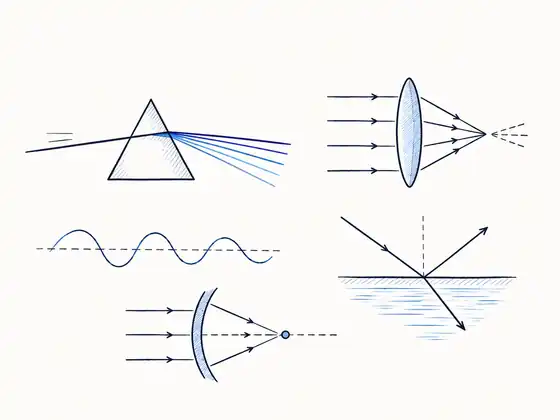
Have you ever looked into the mirror and wondered why our reflection stares back at us so perfectly, or noticed how clouds appear white in daylight and dark at night? Even when we see ourselves in the water, we can see our reflection, but not quite as perfectly as in a mirror. This is all possible due to the fascinating phenomenon of reflection of light. Let’s get to the reflection of light in detail in this note.
Learning Objectives
- Understand the Reflection of Light and its laws.
- Explain the types of reflection, terminologies used in that.
- Conditions to hold the law of reflection.
Introduction
Light usually travels in straight lines, but it changes its path when it strikes a surface; this is called reflection. The laws of reflection explain how light bounces off surfaces, forms images, reflects the glow of sunlight or a calm moon on the water’s surface, and even helps us design devices like optical fibers, periscopes, reflectors, and telescopes. Reflection is why we can see things around us. The ray of light strikes the object and then reaches our eyes; hence, we are able to see that object. One important thing to remember is that reflection occurs within the same medium. If an object lets the light pass through completely, then we cannot see that object, for example, air. In order to be visible to the human eye, an object must reflect light either fully or partially.
Statement of Laws of Reflection
- First Law of Reflection: The incident ray, reflected ray, and the normal to the reflecting surface at the point of incidence all lie in the same plane.
- Second Law of Reflection: The angle of incidence is always equal to the angle of reflection.
These are the two universal laws of reflection — they hold true for all types of reflecting surfaces.
Terms used in Laws of Reflection
There are some terms that students should know before moving further to learn the Laws of Reflection.
- Incident Ray: – The incoming ray of light from the source of light that strikes a surface.
- Point of incidence: – The exact point where the incident ray, reflected ray and normal hits thesurface.
- Normal: – An imaginary line drawn perpendicular to the surface at the point of incidence.
- Reflected Ray: – The ray of light that bounces back from the surface at the point of incidence.
- Angle of incidence: – The angle between the incident ray and the imaginary normal is called the angle of incidence.
- Angle of reflection: – The angle between the reflected ray and the imaginary normal is called the angle of reflection.
- Plane of incidence: – The plane containing the incident ray, reflected ray, and the normal.
- Smooth surface: – A polished surface like a mirror where regular reflection occurs.
- Rough surface: – An uneven surface where irregular reflection occurs.
- Image: – The visual reproduction formed by reflected rays (can be real or virtual).
Conditions for the law of reflection to hold
Usually, reflection from any surface can be observed. However, we cannot see it clearly unless the reflecting surface is smooth. Some points will help to make the image formation clear and predictable if they satisfy the following conditions.
- The reflecting surface should be smooth and polished.
- The incident ray should strike the surface in a defined direction.
- The medium on both sides of the surface should be uniform (like air). If it is non-uniform, we will see the refraction of light.
Types of Reflection
Before we dive into the real-life examples of reflection, it’s important to understand that reflection doesn’t happen in the same way. The nature of the reflecting surface plays a vital role in reflecting light and making an image, which is usually seen behind the mirror. Depending on the types of reflecting surface, there are two types of reflection:
1. Regular Reflection:
- When all the reflected rays from the reflecting surface are parallel to each other, this is called regular reflection.
- Occurs on smooth, polished surfaces such as mirrors.
- It produces a clear, sharp image that appears behind a reflecting surface, such as a mirror or calm water.
2. Irregular Reflection:
- Happens on rough or uneven surfaces, such as walls, paper, or the ground.
- The reflected rays scatter in many directions.
- No clear image is formed.
Key Takeaway 🗝️
Both regular and irregular reflections are important in daily life. Regular reflection gives us clear images (like in mirrors and calm water), while irregular reflection lets us see objects from different angles, making the world around us visible.
Everyday examples of Reflection of light
- Mirrors: When you stand in front of a bathroom mirror or look in your vehicle mirror, you can see the image clearly because light reflects smoothly off their polished surfaces.
- Jewelry: We see several ornaments shining because of their polished surfaces, and they reflect a lot of light when held under a light source.
- Calm Lake or Pond: On a still day, trees and mountains appear almost perfectly on the water’s surface. The water’s smoothness allows parallel reflection, much like a natural mirror.
- Rough wall in Sunlight: When sunlight strikes a brick wall, the uneven surface scatters the light in all directions. This scattering prevents any clear image from forming, but makes the wall visible from every angle.
- Car Headlights on a Wet Road: At night, car headlights on a wet or rough road scatter irregularly. This scattered reflection reduces clarity but helps drivers see the road surface.
Applications of Reflection in Technology
Reflection of light is not just limited to mirrors or waterit plays a vital role in many modern
technologies:
Mirrors and Reflectors:
- Plane and curved mirrors are used in homes, vehicles, and instruments to form clear images.
- Bicycle and car reflectors use reflection to bounce back light for road safety.
Optics Fibers:
- Plane Optical fibers work on the principle of total internal reflection.
- They are widely used in high-speed internet, communication, and medical endoscopy.
Periscopes:
- Periscopes use plane mirrors set at angles to reflect light, allowing people to see over walls or other obstacles.
- Common in submarines and defense applications.
Telescopes and Microscopes:
- Reflecting telescopes use curved mirrors to gather and focus light from distant stars.
- Microscopes use reflection along with lenses to magnify tiny objects.
Laser Devices and Scanners:
- Reflection guides laser beams in printers, barcode scanners, and medical surgeries.
Solar Cookers and Panels:
- Concave mirrors reflect and concentrate sunlight to generate heat in solar cookers.
- Reflective coatings in solar panels improve efficiency by directing more light into the cells.
Frequently Asked Questions
Q.1 Do the laws of reflection apply to curved mirrors?
Yes, they apply to every point on the surface of a curved mirror. The normal at eachrnpoint determines the angles of incidence and reflection.
Q.2 Why is reflection important in daily life?
Without reflection, we wouldnt see objects. It is the basis for mirrors, periscopes,rntelescopes, and even road safety devices.
Q.3 What is lateral inversion?
In a plane mirror, the left side of the object appears as the right side in the image. Thisrneffect is called lateral inversion.
Q.4 Can reflection happen without a mirror?
Yes, any surface, smooth or rough, reflects light. For example, walls, books, or evenrnhuman skin reflect some amount of light.
Q.5 Does reflection always produce an image?
No, only regular reflection produces a clear image (like mirrors or calm water).rnIrregular reflection makes objects visible but does not form a sharp image.
Reference
- Lekner, J. (2016). Theory of reflection.Springer Series on Atomic, Optical, and Plasma Physics,87.
- Beeson, S., Mayer, J.W. (2008). The Reflection of Light. In: Patterns of Light. Springer, New York, NY
- Halliday, D., Resnick, R., and Walker, J. (2014). Fundamentals of Physics. 10th Edition, Wiley and Sons, New York.
- https://byjus.com/physics/laws-of-reflection/#law-of-reflection-formula
- Hecht, Eugene. (2002). Optics (4th ed.). San Francisco: Addison-Wesley.
- https://www.physicsclassroom.com/class/refln/lesson-1/the-law-of-reflection