Newton’s Third Law: Definition, Applications, Misconceptions, & Examples
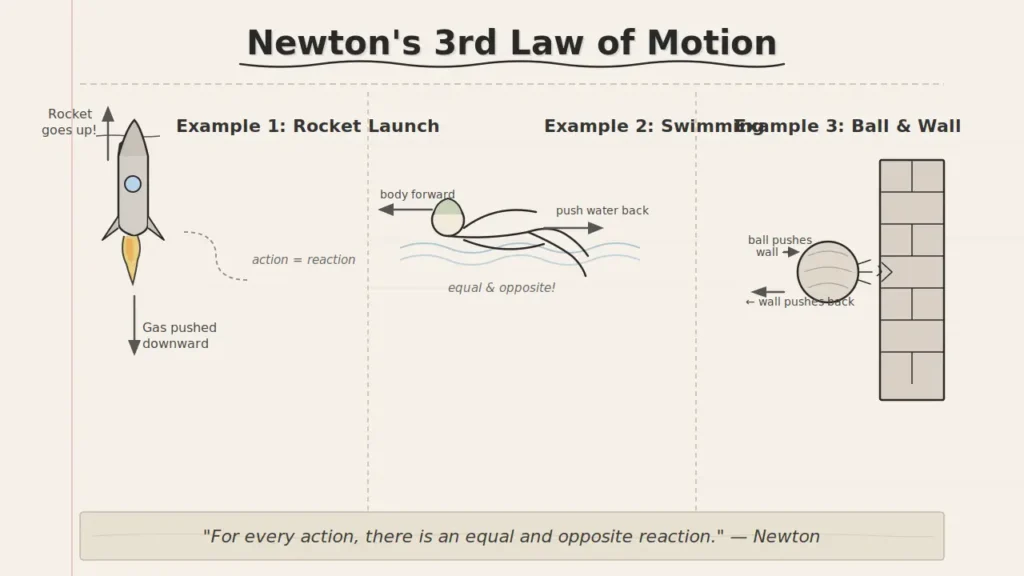
Action and reaction pairs explained using everyday examples and free-body reasoning. Read more about Newton’s Third Law: Definition, Applications, Misconceptions, & Examples

Mechanics is the branch of physics that studies the motion of objects and the forces responsible for causing or changing that motion. It is basically grouped into Newtonian Mechanics and Quantum Mechanics, both of which are important.
It is the oldest and most foundational area of physics, forming the basis of virtually every engineering and applied science discipline. Additionally it is is divided into kinematics — which describes how objects move — and dynamics — which explains why they move as they do. At advanced levels, it extends into rigid-body mechanics, fluid mechanics, and relativistic mechanics.
You can find the applications of mechanics in almost every field:
The core ideas of mechanics — Newton’s laws, force, energy, momentum, and gravitation — explain an enormous range of phenomena using a small set of powerful principles.
These notes build your understanding from the ground up, connecting theory directly to real-world situations. Enjoy Reading !!!
Action and reaction pairs explained using everyday examples and free-body reasoning. Read more about Newton’s Third Law: Definition, Applications, Misconceptions, & Examples

Everything you need to understand F = ma — statement, units, free-body diagrams, component form, common misconceptions, and… Read more about Newton’s Second Law: Definition, Units, Applications & Examples

Inertia is explained through simple examples, conceptual traps, and classroom demonstrations. Effects of equilibrium, misconceptions of inertia, types… Read more about Newton’s First Law (Law of Inertia): Definition, Examples & Applications