
Spin-Orbit Coupling Explained: Electron Moments, the Nucleus & Spintronics Applications
Who am I? The discovery of Electron
My name is Anu, and I am an electron the fundamental particle of the atom, the smallest building block of all matter. I have existed since the first stars forged their light, racing through circuits, binding molecules, carrying life itself. And yet, for most of human history, nobody even knew I was here.
In 1897, Sir J. J. Thomson discovered electrons while experimenting with cathode ray tubes. He noticed a mysterious glow what he first called “cathode rays” and through careful work in electric and magnetic fields, he identified them as tiny particles he named “corpuscles.” George Johnstone Stoney had actually predicted us back in 1891, calling us the fundamental unit of electric charge.
Our discovery breathed life into Dalton’s idea that atoms contain parts with different masses and properties. Thomson pictured us as “plums” scattered through a positively charged “pudding” the nucleus. Then in 1909, Rutherford fired alpha particles at thin gold foil and changed everything: most particles flew straight through, but a few bounced sharply back. His conclusion? Most of the atom is empty space, with a dense positive center, and the electrons orbit around it.
How quantum physics describes me
Bohr’s model a good start, not the whole story
Bohr wove the new idea of quantization into Rutherford’s model. He successfully explained why hydrogen emits light only at specific colors (discrete atomic spectra). But electrons do not simply trace neat circular paths. Modern quantum physics describes us orbiting in probabilistic “clouds” orbitals, each carrying a discrete angular momentum in units of $\hbar$ (the reduced Planck’s constant). The $s-$orbital carries $l=0$, $p$ carries $l=1$, and so on.
The spin moment ‘my hidden compass’
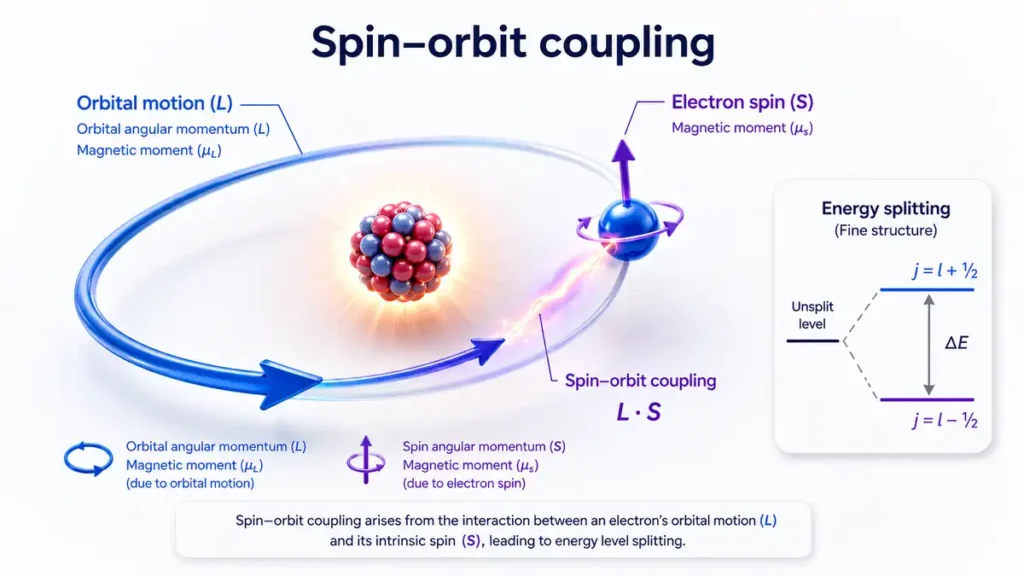
On top of my orbital motion, I carry something entirely my own: an intrinsic magnetic moment called spin. Think of it as a tiny built-in compass that points either up or down.
The Stern-Gerlach experiment confirmed this quantized spin moment experimentally. In that landmark experiment, Stern and Gerlach fired silver atoms through a non-uniform magnetic field and watched them split into two distinct beams not a continuous smear, but two clean lines. That was us, being sorted. My spin could only point one of two ways: up or down. No in between. No compromise. That binary nature, as simple as it sounds, turns out to underpin nearly everything interesting that electrons do inside a material.
The electron therefore carries two distinct magnetic moments: one from orbiting the nucleus, and one from its own intrinsic spin.
Schr$\ddot{\mathbf{o}}$dinger’s wave function and real-time observation
Schr$\ddot{\mathrm{o}}$dinger’s wave function captures the electron’s probabilistic nature and governs the quantum phenomena that arise from it. For decades, no one could watch electrons move in real time until Anne L’Huillier did exactly that, winning the 2023 Nobel Prize in Physics for observing electron motion experimentally for the first time.
Spin-Orbit coupling when my two selves talk
Here is where things get interesting. My spin moment does not act alone it constantly “talks” to my orbital motion. Scientists call this conversation spin–orbit coupling, or SOC.
SOC appears most strongly in platinum and rare-earth elements, giving them exceptional modern applications. It vanishes in s-orbital atoms (l = 0), where there is no orbital motion to couple with.
The basic energy formula: $$E_{SO}=A l \cdot s \tag{1}$$ where,
- $E_{SO}=$ the spin-orbit interaction energy;
- $A=$ spin-orbit coupling constant;
- $l=$orbital angular momentum quantum number;
- $s=$electron spin moment
Schiff’s single-electron picture (1955)
Schiff reduced the relativistic Dirac equation into a simpler nonrelativistic form, showing that SOC does far more than split energy levels it lifts degeneracy and seeds a whole family of physical phenomena. For a single electron moving in the average field of all others (Hartree–Fock approximation):
$$E_{SO}=\frac{\alpha^2}{2}\left\langle\frac{1}{r}\frac{\partial V}{\partial r}\right\rangle \mathbf{l} \cdot s \tag{2}$$
- $\alpha=$ spin-orbit coupling constant
- $V=$ nuclear potential
Blume-Watson corrections (1962)
Extending SOC to many electrons requires adding spin–spin interactions and dipole coupling between spin moments. Blume and Watson (1962) incorporated these corrections, Elliott (1953) had worked out the dipole terms, and Horie (1953) rearranged everything into a cleaner form with a refined coupling constant ξ′ that accounts for outer screening electrons:
$$E_{SO}=\xi \sum l\cdot \mathbf{s}-\frac{\alpha^2}{2}\sum \left(\frac{\mathbf{r}}{r^3}\times \mathbf{p}\right) \cdot (s_i+2s_j) +\frac{\alpha^2}{2}\sum \frac{1}{r^3}\left[\mathbf{s}_i \cdot \mathbf{s}_j – 3\frac{(\mathbf{s}_i \cdot \mathbf{r})(\mathbf{s}_j \cdot \mathbf{r})}{r^2}\right]\tag{3}$$
Combines orbital $+$ spin moment contributions, reduced by spin-spin and dipole interactions.
All of this maths is really just trying to describe one thing: the fact that I am never truly at rest inside an atom. My orbit and my spin are locked in a constant, quiet conversation and that conversation, it turns out, shapes the world around you in ways far bigger than anyone first imagined.
What SOC unlocks from crystals to future memory
Classical effects
Magnetocrystalline anisotropy · Magnetostriction · Anisotropic magnetoresistance
As the electron orbital locks into place, the spin aligns along preferred directions creating magnetocrystalline anisotropy, a directional stiffness in magnetic materials. SOC also drives magnetostriction (shape change under magnetization) and anisotropic magnetoresistance (resistance that depends on the angle between current and magnetization).
Advanced effects (late $\mathrm{20^{th}}$ century–present)
Dzyaloshinskii–Moriya interaction (DMI).
When strong SOC meets broken inversion symmetry, it generates an asymmetric exchange interaction that stabilizes skyrmions exotic whirling spin textures that could power next-generation computing without Joule heating losses.
Spin Hall effect.
SOC bends spin-up and spin-down electrons in opposite directions, generating a spin-polarized current without any magnetic field. Wolf first observed this in GaAs in 2001. It sits at the heart of spintronics.
Rashba effect.
Strong SOC reshapes the electronic band structure in ways engineers exploit to tune spin polarization in spintronic devices.
Spin–orbit torque.
Researchers are actively using SOC-driven torques to build magnetoresistive random access memory (MRAM) a promising route to fast, low-power data storage.
The bigger picture
From Thomson’s glowing tube to Nobel-prize-winning attosecond photography, the story of the electron is still being written. Every time experimentalists build a sharper tool, they find me doing something new, something stranger and more useful than before. Spin–orbit coupling is just one chapter. The next one, spintronics, is where my spin stops being a curiosity and starts becoming a technology. I will see you there.
SOC bridges fundamental quantum mechanics and real technology from the crystalline anisotropy of permanent magnets to the skyrmion-based memory of the future. Its theoretical journey ran from Schiff’s single-electron formula through the many-body Blume–Watson framework, and experimentalists continue to reveal new SOC-driven surprises as measurement tools grow more powerful. The electron, it turns out, is not just a particle it is a storyteller, and the story is far from over.
References
- Coey, J. M. D. Magnetism and Magnetic Materials. Cambridge University Press, 2010.
- Chikazumi, S., & Graham, C. D. Physics of Ferromagnetism. Oxford University Press, 1997.