
Optics

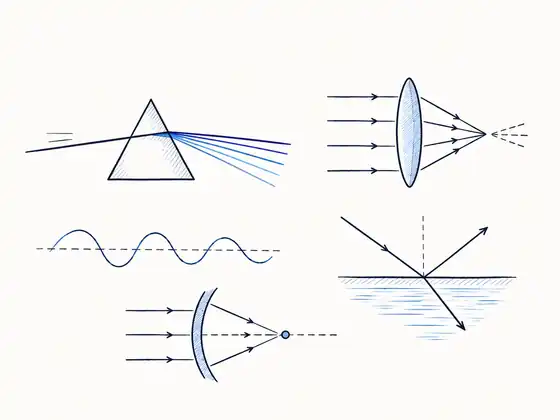
Optics is a fundamental branch of physics that explores how light interacts with matter, propagates, and produces phenomena like reflection and refraction, helping students connect physics to everyday experiences. It is basically studying the behavior of light.

Several phenomena fall under optics, including reflection, refraction, polarization, and interference, which mainly involve the visible spectrum of electromagnetic waves from 380 nm to 700 nm and relate directly to many devices we use daily.

As one of the oldest scientific fields, optics introduces light as rays in simple terms, then connects to wave physics-where light acts as an electromagnetic wave-and quantum mechanics, which describes light as particles called photons, illustrating the wave-particle duality essential to understanding modern physics.

The applications of optics are central to modern science and technology:

  • Fiber optic communication — carrying internet data as pulses of light through glass fibers.
  • Medical Imaging — endoscopes, laser surgery, and optical coherence tomography.
  • Cameras and telescopes — using lenses to focus light and form sharp images.
  • Microscopy — revealing structure at scales invisible to the naked eye.
  • Lasers — used in surgery, manufacturing, and scientific research.
  • Vision correction — eyeglasses and contact lenses work by bending light before it enters the eye.

The study of optics begins with reflection and refraction, fascinating phenomena that lead to the design of lenses, mirrors, and optical instruments that reveal the universe’s beauty and complexity.

These notes explain each concept clearly with examples that connect the physics of light to the world you can see. Enjoy reading!!!