
History of Magnetism: A Complete Guide from Ancient Lodestones to Modern Science
Magnetism is visible all around us from fridge magnets to computer hard disks. This article discusses how the word magnetism came into existence and how its understanding has evolved over time.
Learning Objectives
- Understand the etymology of the word "magnetism" and trace its linguistic evolution from ancient Greek to modern English.
- Identify the early key applications of magnetic materials.
- Short description of the contributions of different scientists.
- Role of quantum mechanics in the understanding of magnetism
Origin of the word “Magnetism”
The word magnetism derives from the Greek word “$magn\bar{e}tis$”, meaning “stone from Magnesia,” a place in Thessaly, Greece, known for its natural deposits of lodestone (magnetite, $FeO·Fe_2O_3$). From Greek, it entered Latin as “$magnes$“, then passed into Old French, and finally became “$magnetism$” in English around the $16^{th}$ century.
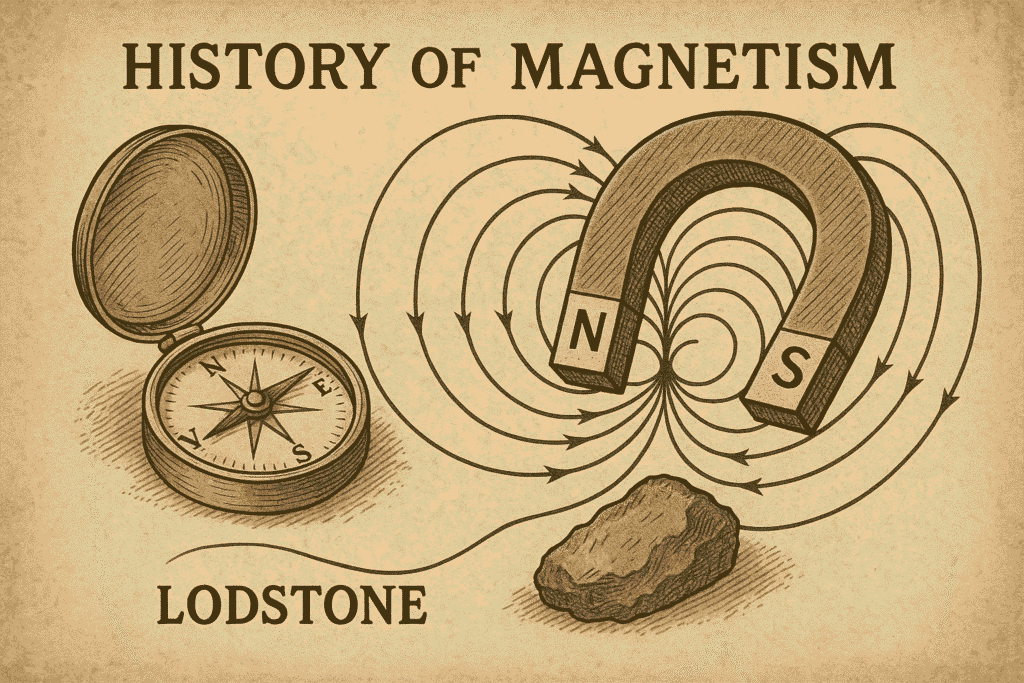
First Understanding and Application of Magnetic Material
A small piece of lodestone, when suspended or floated in water, aligns itself in the north-south direction. Over time, sailors discovered that an iron needle magnetized with a lodestone produces the same result when floated in water; this floating magnetized needle is known as a compass.
The Compass Humanity’s First Magnetic Tool
The first book on magnetism, De Magnete, Magneticisque Corporibus, et de Magno Magnete Tellure (On the Loadstone and Magnetic Bodies and on the Great Magnet the Earth), was published in 1600 by William Gilbert. In it, this English physician to Queen Elizabeth I laid the foundations for understanding Earth as a giant magnet, and studied the lodestone and its early relation to electricity. Gilbert is also known as the Father of Magnetism. During his observations, he noted that after removing the lodestone from an external field, it rotated toward the direction of the field, a phenomenon that persists at the quantum level in single-spin-moment behavior.
Ancient Exploration of the Magnetic Lodestone
China: The Earliest Known Use
The earliest use of compass needles was recorded in China, from around the $2^{nd}$ century CE.
India and the Islamic World
Trade routes from China and India, as well as Islamic mariners, likely introduced this directional tool across regions. In Indian Sanskrit texts, it was known as matsya-yantra, as floating iron needles shaped like fish were used for direction-finding. From the Islamic world, the compass knowledge traveled further westward.
Arrival in Europe
The first account of the compass in European literature appears in the $12^{th}$-century book De Naturis rerum by Alexander Neckam
Magnetism in Nature and Living Organisms
Animal Navigation and Biomagnetism
Magnetism is also used by living beings for navigation, including the migration of birds, crabs, sea turtles, and certain worms.
Earth’s Magnetic Field and the Aurora
Earth’s magnetic field has not been static; it has evolved over time and even flipped its orientation, as geological rock specimens reveal. This field is not only used by living beings for adaptation, but is also one of the reasons life exists on Earth. It protects living creatures from the Sun’s harmful solar flares and when it does so, it produces the natural phenomenon known as the Aurora.
Contributions of Scientists to the Understanding of Magnetism
William Gilbert and the Foundation (1600)
The discovery of the lodestone laid the path for the field of magnetism in ancient times. William Gilbert’s De Magnete remains the earliest landmark in formal magnetic science.
The $\mathbf{18^{th}-19^{th}}$ Century: Electricity and Magnetism United
In the $18^{th}$ century, extensive studies by Ørsted, Ampère, Gauss, Faraday, and Henry established the relationship between electricity and magnetism and explained their co-dependency.
Maxwell and Hertz: Theoretical and Experimental Breakthroughs
The theoretical understanding of electromagnetism came from Maxwell’s equations, formulated by James Clerk Maxwell, a 19th-century Scottish scientist. These equations hold the same importance in electromagnetism as Newton’s laws do in classical mechanics. Heinrich Hertz later provided the experimental proof of Maxwell’s equations through the generation and detection of radio waves (electromagnetic waves).
Curie, Langevin, and the Thermodynamics of Magnetism
How magnetic materials lose their magnetism upon heating to a certain temperature was explained by Pierre Curie; this threshold is known as the Curie temperature. Paul Langevin, a French scientist, provided a statistical-mechanical explanation of paramagnetism and diamagnetism. However, ferromagnetic materials could still not be fully explained by classical physics, as their magnetic properties showed greater complexity than what dynamic electric fields alone could account for.
The Arrival of Quantum Mechanics
Quantum Explanations of Ferromagnetism
As quantum physics evolved, a deeper understanding of superposition, the quantization of atomic energy levels, spin operators, spin-orbit coupling, and the probabilistic treatment of symmetric and asymmetric wavefunctions provided the tools needed to decipher the mysteries of the lodestone. Modern physicists such as Pierre Weiss, Werner Heisenberg, Lev Landau, Louis Néel, and Felix Bloch used quantum tools to explain exchange interactions in ferromagnets, phase transitions from magnetic to non-magnetic states, the canting of magnetic moments, and dynamic magnetic fields through quanta called magnons
$\mathbf{20^{th}-21^{st}}$ Century: GMR, Spintronics, and the age of AI
Toward the end of the $20^{th}$ century and into the $21^{st}$, scientists discovered phenomena such as Giant Magnetoresistance (GMR), exchange bias, and topological magnetic textures. A new subfield, spintronics, has emerged with the potential to make computing and data storage far more energy-efficient, a critical need in the current era of Artificial Intelligence (AI).
References
- Coey, J. M. D. Magnetism and Magnetic Materials. Cambridge University Press, 2010.
- Neckam, Alexander. De Naturis Rerum. Cambridge University Press, 2012.
- Chikazumi, S., & Graham, C. D. Physics of Ferromagnetism. Oxford University Press,
1997. - Goforth, Kayla M., et al. “Learned Magnetic Map Cues and Two Mechanisms of Magnetoreception in Turtles.” Nature, vol. 638, no. 8052, 2025.